
How Long Does It Take to Align Tires? Typical Times and What Changes Them
By Ameer8 min read
Quick Takeaways
- Most alignments take about an hour or less, and a 4-wheel alignment takes only a little longer than a 2-wheel one.
- Trucks, SUVs, and cars with worn or seized suspension parts can take longer.
- Watch for pulling, an off-centre steering wheel, and uneven tire wear.
- Have your alignment checked about once a year, and after new tires or a hard pothole hit.
How long it takes to align tires depends on the vehicle and the condition of its suspension, but most alignments are done in about an hour or less.
How Long Does It Take to Align Tires?
A typical wheel alignment takes about 45 to 60 minutes, and Pirelli says it should usually take an hour or less. Some shops finish simple jobs in around 30 minutes, but that’s a best case. Plan for an hour, and more if you’re also getting tires installed.
You may see claims that an alignment takes only 20 minutes. That can be true for a quick check on a vehicle that’s already close to spec, but a full alignment where the technician actually adjusts the angles rarely fits in that window. Time also depends on the shop’s equipment and how busy it is, and your wait can easily be longer than the work itself.
What Happens During the Appointment
An alignment is a short sequence, which is why the time is fairly predictable:
- Inspection. The technician checks tires, steering and suspension for worn or damaged parts.
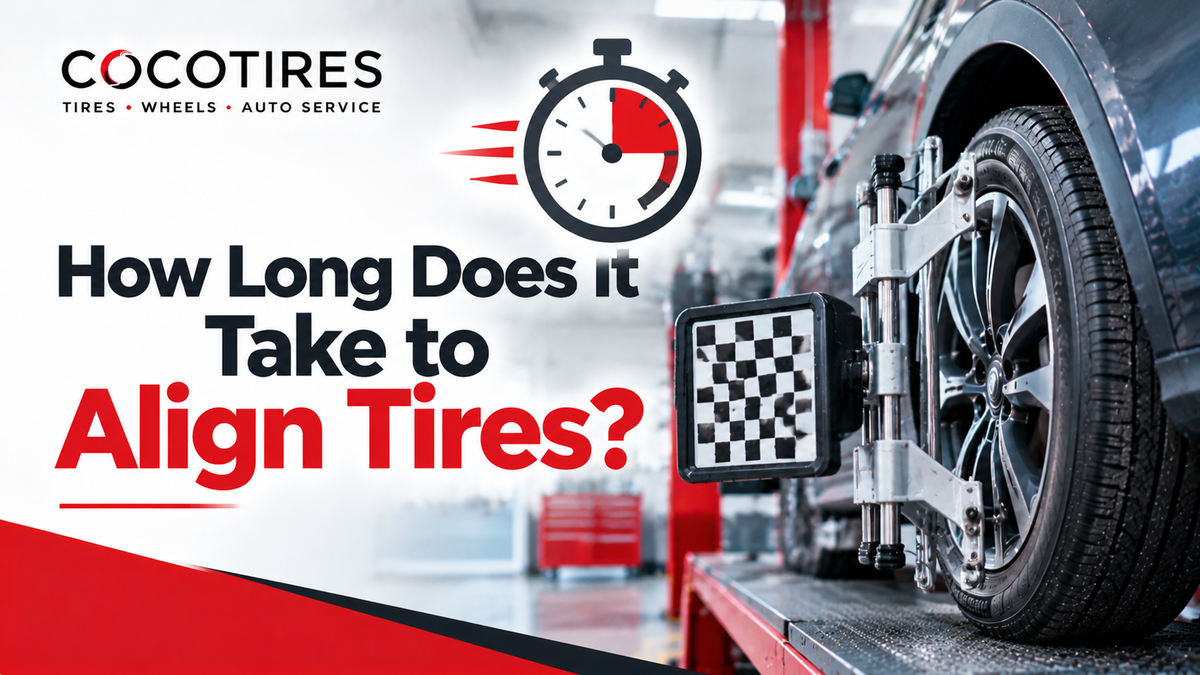
- Measuring. Sensors on each wheel read the camber, toe and caster angles against your vehicle’s factory specs.
- Adjusting. The technician adjusts the suspension until the angles are back within spec.
- Final check. Many shops finish with a printout and a short test drive to confirm the steering wheel sits straight.
The inspection is where surprises show up. If everything is in good shape, the adjusting stage is quick. If a part is worn or stuck, that’s where extra time goes.
How Long Does a 2-Wheel vs 4-Wheel Alignment Take?
A 4-wheel alignment usually takes about 60 to 90 minutes, while a 2-wheel (front-end) alignment takes roughly 45 to 60 minutes. It’s tempting to assume a 2-wheel job takes half as long, but it doesn’t. The technician still sets up the equipment, measures and adjusts, so the difference is small.
Which type you need depends on your vehicle. All-wheel-drive vehicles and many cars with an adjustable rear suspension need a 4-wheel alignment. A front-end alignment is common on some front-wheel-drive and rear-wheel-drive vehicles with non-adjustable rear suspensions. Your owner’s manual or the shop can tell you which one applies, and for most newer cars a 4-wheel alignment is the safer default.
If you only want a tire alignment check, meaning a measurement without adjusting, expect it to take less time, often under half an hour. If the readings are off, the shop will usually recommend the full alignment.
How Long Does an Alignment Take on a Truck, SUV or Compact Car?
A compact car like a Corolla generally sits at the quicker end of the range, while a truck or SUV can take longer. Larger vehicles often have more complex suspension, heavier components and sometimes lift kits or aftermarket parts that make adjustments slower. Plan for up to about two hours on a truck if the shop finds anything unusual.
If you drive a larger vehicle, it’s worth confirming that your shop has the right equipment and experience before you book. When you’re choosing replacement tires for it, browse our truck and SUV tires by size, and check the load index in your owner’s manual.
Why Is My Alignment Taking So Long?
Alignment drags on when the technician finds something that needs fixing before the angles can be set. Common causes include seized or rusted adjustment bolts (frequent on Canadian vehicles after salted winter roads), worn tie rods, ball joints or bushings, and bent suspension parts from a pothole or curb hit.
Parts that are too worn to hold an adjustment need replacing first, and that can turn a one-hour visit into a half-day job if parts have to be ordered. Vehicles with electronic steering systems may also need a calibration step after the alignment. If your shop quotes a long wait, ask what they found and whether the repair is urgent. That’s a normal question, and a good shop will explain.
Is an Alignment Needed After New Tires?
An alignment after new tires isn’t legally required, but it’s smart, because misalignment wears a new set unevenly and shortens its life. Many tire retailers recommend having it done at the same appointment. A tire change plus alignment usually takes roughly an hour and a half in total, since mounting and balancing four tires is a separate job.
If you’re buying tires online, our guide to buying tires online in Canada walks through the process, including getting them fitted. Book the installation and alignment together, and ask for the alignment readings before and after so you can see what changed.
Signs of Bad Alignment
The main signs of bad alignment are your car pulling to one side, a steering wheel that sits off-centre when you drive straight, uneven or fast tire wear, and a steering wheel that shakes. Continental Tire lists the same signals, and also notes that vibration at speed more often points to unbalanced wheels, so it isn’t proof of misalignment on its own.
Alignment problems also build slowly, so you may not notice them until your tires wear out early. You may also hear tires scrub or squeal on turns, or feel the steering getting looser or more tiring to hold straight.
Here’s a quick check you can do yourself: on a flat, empty road, drive slowly in a straight line and loosen your grip slightly. If the car drifts steadily to one side, book an inspection. This is only a rough test and not a substitute for proper measurements.
Does alignment affect steering? Yes. Misaligned wheels can pull the car off-line, make the steering wheel sit crooked and make steering feel heavy or vague. After a proper alignment, most drivers notice the car tracks straighter, the steering feels lighter and more centred, and tire wear evens out. Don’t expect a dramatic change on a car that was only slightly off, though.
Can You Drive With Bad Alignment? How Urgent Is It?
You can drive with mild misalignment for a short time, but it isn’t something to put off for months. Bad alignment wears tires unevenly, can raise fuel use slightly and can make the car harder to control in emergencies, especially on wet or snowy roads.
A rough guide:
- Mild pull or slight uneven wear: book within a few weeks.
- Strong pull, steering wheel well off-centre or fast edge wear: book soon, before you spend more on tires.
- After a hard pothole or curb impact, with shaking or a change in steering: have it inspected right away, since there may be suspension damage.
How Long Does a Wheel Alignment Last?
A wheel alignment doesn’t last forever. Tire retailers often suggest an alignment every two to three years if you notice no problems, but Canadian conditions are harder on suspension than that implies. Kal Tire says that about 60% of the vehicles they check are out of alignment, and it recommends checking once a year, or at your seasonal tire changeover.
Winter potholes, frost heave and curbs all knock suspension out of position. A simple habit is to ask for an alignment check when you swap between summer and winter tires, and again after any pothole hit or suspension repair. Alignment also matters after replacing suspension or steering parts like struts, tie rods or control arms.
Can I Fix Car Alignment Myself?
Not accurately. Home methods like string lines or tape measures can give a rough idea of toe, but they can’t measure camber and caster to the precision modern vehicles need. Alignment needs calibrated equipment and your vehicle’s factory specs. If you suspect a problem, a professional inspection is the reliable route, and getting it wrong can wear tires faster than leaving them alone.
FAQs
What’s the difference between alignment and balancing?
Alignment adjusts the angles of your wheels so they meet the road correctly. Balancing corrects uneven weight distribution in a wheel and tire, which usually shows up as vibration at speed. They’re separate services, though they’re often done together.
Is alignment the same as tire rotation?
No. Rotation means moving tires between positions to even out wear, while alignment adjusts the suspension angles. Rotation won’t fix a car that pulls, and alignment won’t replace regular rotation.
What are camber, toe and caster?
Camber is the inward or outward tilt of the wheel when viewed from the front. Toe is whether the front of the wheels points in or out, and caster is the angle of the steering axis. Your shop adjusts all three to your vehicle’s specifications.
Conclusion
How long it takes to align tires usually comes down to about an hour, with extra time for trucks, 4-wheel jobs and worn parts. Don’t wait for tires to wear out: check alignment about once a year, after new tires and after any hard impact. When it’s time for a new set, shop tires by size at COCOTIRES. We offer free shipping across Canada and a 7-day return policy, and you can read the details on our shipping and return pages.
Frequently asked questions
What’s the difference between alignment and balancing?
Alignment adjusts the angles of your wheels so they meet the road correctly. Balancing corrects uneven weight distribution in a wheel and tire, which usually shows up as vibration at speed. They’re separate services, though they’re often done together.
Is alignment the same as tire rotation?
No. Rotation means moving tires between positions to even out wear, while alignment adjusts the suspension angles. Rotation won’t fix a car that pulls, and alignment won’t replace regular rotation.
What are camber, toe and caster?
Camber is the inward or outward tilt of the wheel when viewed from the front. Toe is whether the front of the wheels points in or out, and caster is the angle of the steering axis. Your shop adjusts all three to your vehicle’s specifications.