
Tire Tread Depth: A Comprehensive Guidlines
By Ameer7 min read
Quick Takeaways
- New passenger tires start at roughly 10/32" to 12/32" (about 8 to 9.5 mm) of tread.
- The legal minimum is 1.6 mm (2/32"), but grip drops well before that.
- Plan to replace tires around 4 mm (5/32"), and winter tires by about 4.8 mm (6/32").
- A tread depth gauge is the most accurate tool, and a Canadian quarter is a quick backup.
Tire tread is the pattern of grooves and ribs on the surface of your tire, and its depth decides how well you grip wet and snowy roads. If you’ve wondered how much tread is enough, you can check it in a few minutes with a gauge or a coin.
What Is Tire Tread and Why Does It Matter?
Tread is the rubber on your tire that touches the road, shaped into grooves, ribs and small slits called sipes. The grooves channel water away so the tire stays in contact with the pavement, and in winter they bite into snow. As tread wears down, the tire clears water less well, which raises the risk of aquaplaning and lengthens stopping distances.
A new passenger tire usually starts at about 10/32" to 12/32", which is roughly 8 to 9.5 mm, depending on the type and brand. Winter and all-terrain tires often start deeper. In Canada, tread depth is usually quoted in 32nds of an inch (the way gauges and most tire guides show it) or in millimetres, so you’ll see both throughout this guide. A “normal” tread depth is simply anything between new and your replacement point, which is covered below.
How to Check Tire Tread
You can measure tire tread three ways: with a tread depth gauge, a Canadian quarter or the wear bars built into the tire. Use whichever is handy, but a gauge gives you the most reliable number.
With a Tread Depth Gauge
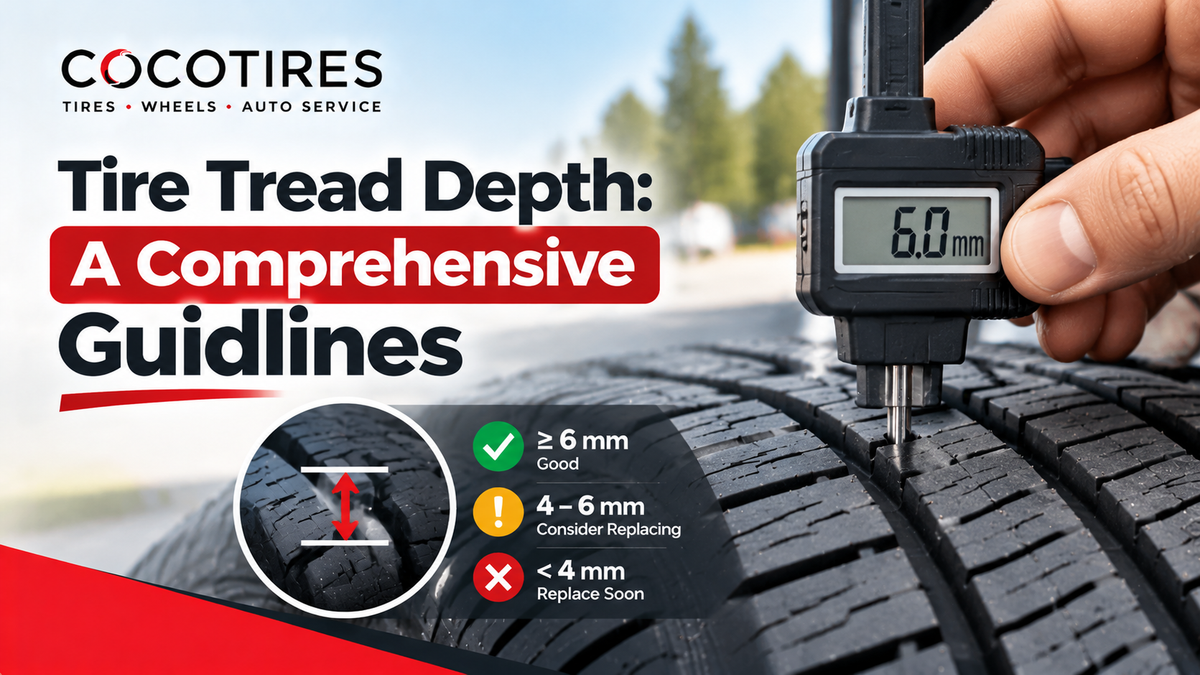
A tread depth gauge is a small, inexpensive tool that gives a precise reading in 32nds of an inch or millimetres. To use one, push the probe into a main groove until the base sits flat on the tread surface, then read the number the gauge shows. Take readings at several points across each tire (inside, middle and outside) and again around the tire’s circumference. Use your lowest reading, because that’s the spot that wears you out first.
Most gauges read in 1/32" steps, so you’ll see values from 2/32" up to the tire’s original depth. A gauge also tells you when the tread is wearing unevenly, which a coin can’t show as clearly.
With a Canadian Quarter
The quarter test is a fast, free check. Michelin Canada describes it like this: put a Canadian quarter into the deepest groove with the caribou’s nose pointing down. If the nose is completely covered by tread, you have more than 6/32" left. If you can see the tip of the nose, you’re at or under that point, and it’s time to start planning for replacement.
Treat it as a rough check, not a measurement. It’s hard to do accurately on a mounted tire, and it can’t tell 5/32" from 4/32". If the coin test leaves you unsure, use a gauge.
With the Wear Bars
Every tire has raised bars moulded into the bottom of its main grooves. When the tread wears down level with those bars, you’re at 1.6 mm (2/32"), which is the end of the tire’s legal life, and you should replace it right away. That’s what 1.6 mm looks like in practice: smooth rubber strips running across the groove, flush with the tread. If you can see exposed cords or fabric, stop driving on the tire.
Tire Tread Depth Chart: 10/32" to 2/32" Explained
This chart shows what each depth means, using a new tire of about 10/32" as the baseline for the percentage column.
| Tread depth | Millimetres | Approx. tread left | What it means |
|---|---|---|---|
| 9/32" | 7.1 mm | 90% | Nearly new. |
| 8/32" | 6.4 mm | 80% | Plenty of tread for all conditions. |
| 7/32" | 5.6 mm | 70% | Good. A tread of 7/32" is a healthy tire. |
| 6/32" | 4.8 mm | 60% | Still fine, and the point where winter performance starts to fade. |
| 5/32" | 4.0 mm | 50% | Time to start shopping, especially for snow and rain. |
| 4/32" | 3.2 mm | 40% | Replace soon. Wet braking is clearly reduced. |
| 3/32" | 2.4 mm | 30% | Replace now for wet or winter driving. |
| 2/32" | 1.6 mm | 20% | Legal limit. Replace immediately. |
A few common questions fit in this chart:
- Is a tread depth of 4/32" okay? It’s legal but already worn. Many experts suggest replacing at about 4/32", so don’t wait for the wear bars.
- Is 40% tread good? Not really. On most tires that’s about 4/32", which is the point where you should be replacing them.
- Is 2.5 mm tire tread okay? It’s above the legal limit, but below the 3.2 mm many experts recommend. It’s worth replacing before wet or snowy weather.
- How long do tires at 50% tread last? Typically about half their tread life remains, but it depends on how you drive and on wear patterns. For winter tires, 50% is already close to the point where snow grip is reduced.
Legal Minimum vs Safe Tread Depth in Canada
The legal minimum for most tires in Canada is 1.6 mm (2/32"). Provinces set their own rules and some are stricter, so check your province’s transport ministry for the current number that applies to you.
Legal doesn’t mean safe, though. How much tire tread is bad? Tire Rack tested wet braking and found that tires at 2/32" took nearly twice the distance to stop compared with new tires, while 4/32" tires fell in between. That’s why many tire makers recommend replacing before the legal limit.
A simple three-step rule for passenger cars:
- Above 5/32" (4 mm): fine for everyday driving.
- 4/32" to 3/32": replace soon, especially if you drive in rain or snow.
- 2/32" (1.6 mm) or less: replace now.
If you’ve decided it’s time, you can browse all-season tires by size.
Winter Tire Tread Depth
Winter tire tread depth matters earlier than the legal minimum, because snow traction relies on deep grooves. Quebec’s SAAQ recommends at least 4.8 mm (6/32") when you install winter tires, and tires worn to about 4 mm shouldn’t be used on snow-covered roads. Many winter tires also have their own wear indicators, so check the tire’s markings.
Measure your winter set before each season and replace it if it’s close to those limits. Our guide on when to change winter tires covers timing, and you can shop winter tires by size when you’re ready.
How Long Do Tires Last?
The lifespan of a tire depends on both tread wear and age. Tread life varies by tire type, vehicle, driving style and road conditions. Under-inflation, hard cornering, heavy loads and poor alignment all speed up wear, and regular rotation helps tires wear evenly.
Age matters too, because rubber hardens and cracks even on tires that rarely move. Check the four-digit DOT code on the sidewall: “1316” means the 13th week of 2016. A common guideline is to have tires inspected once they’re about five years old, and to replace them by ten years at the latest, whatever the tread looks like. Always follow your tire maker’s and owner’s manual advice.
Reading Uneven Wear
Where the tread wears tells you what’s wrong, which is worth knowing before you buy a new set:
- Wear in the centre: usually over-inflation.
- Wear on both edges: usually under-inflation.
- Wear on one edge: often an alignment problem.
- Scalloped or cupped patches: often worn suspension parts or unbalanced wheels.
Fix the cause before you fit new tires, or the new set will wear the same way. Set pressures in kPa to the figure on your door placard, since cold air lowers pressure.
Conclusion
Checking tire tread takes a few minutes: use a gauge or a Canadian quarter, check the wear bars and measure at several points on each tire. Treat 1.6 mm as the legal floor rather than the target, plan to replace around 4 mm and replace winter tires earlier. When it’s time for a new set, shop tires by size at COCOTIRES. We offer free shipping across Canada and a 7-day return policy, and you can read the details on our shipping and return pages.